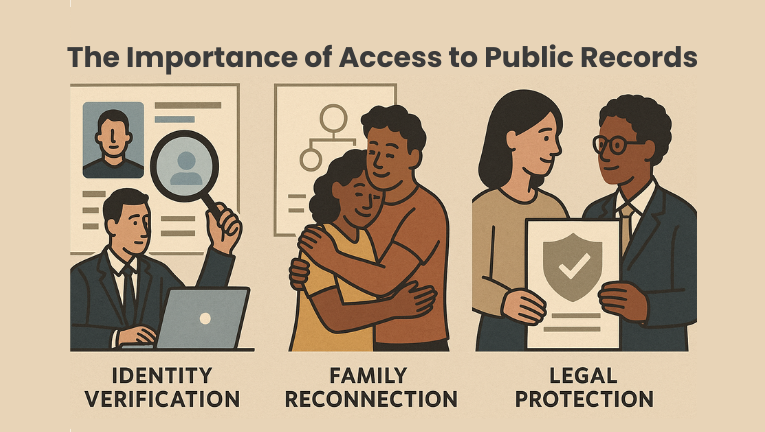

Public records are crucial in a democracy. They provide the public with access to information that helps ensure transparency and supports citizens' legal rights.
In addition to providing insights into background records, publicly available data can help you find people from your past. Long-lost loves, a friend you lost touch with, a family member you’ve been trying to contact –public records can help you track down information to reconnect with almost anyone!
In this guide, we’ll review how public records access is important for maintaining transparency in government, creating trust, and reconnecting.
We’ll also cover how to remove your publicly available records from visibility. Boosting your online privacy can have unintended negative consequences, so weighing the pros and cons can help you make the right decision for your privacy needs.
Why Public Records Exist and Why They Matter
“Access to public records is one of the quiet pillars of an accountable, informed, and empowered society. As an individual, and especially as a lawyer, I see this access not just as a right, but as a tool that fosters transparency, protects people from fraud, and allows us to make better decisions, whether in business, real estate, or personal matters.” - Kalim Khan, Co-founder & Senior Partner at Affinity Law
Public records, whether land titles, court rulings, corporate filings, or marriage licenses, are a form of institutional memory. They allow us to verify facts, trace ownership, hold people accountable, and establish legal clarity.
That kind of openness creates a deterrent against dishonesty.
The need to keep politicians, the elite, and every day citizens accountable to the public is a tale as old as time and public records have played a key role in preventing the powerful from taking advantage of their positions.
Public records have their origin in ancient civilizations like Rome, where official records were kept to track laws, property ownership, and census numbers. These records were on public display to allow all citizens to reference the data, much like our current public records process.
During medieval times, only the privileged and elite had access to records of public actions, ownership, and law.
Luckily, the rise of democratic ideals in government led to a shift in public perception. It became a widespread belief that the records of the citizens should be made available to the public and not just those in power.
Allowing everyone, regardless of status, to view public records helps ensure that there are no unfair advantages in information access.
Having access to public records empowers citizens to make more informed decisions.
Aside from being a cornerstone for democracy, access to public data benefits many fields by facilitating research, policy analysis, and civic engagement.
Ensuring Government Transparency and Accountability
“Public records are a cornerstone of investigative journalism, offering verifiable insights that can expose corruption, uncover hidden truths, and strengthen reporting…
By understanding how to locate, analyze, and ethically use public records, journalists can add depth and credibility to their work, building trust with their audiences and holding power to account. In an age where disinformation and misinformation threaten the integrity of the press, public records stand as a beacon of truth—waiting for diligent reporters to unlock their potential.” - Foreign Press Correspondents USA
Journalists, watchdogs, and even everyday citizens can access and use public records to monitor government officials' activities. Some examples of the records they may be able to access are:
- meeting minutes
- contracts or procurement records
- court filings
- police reports
- bodycam footage and logs
- environmental permits and inspection records
- civil lawsuits and settlements
- criminal charges
Public records are one of the core investigative tools that journalists rely on to gather information. Without access to these valuable records, it would be difficult for reporters to keep the public aware and politicians accountable.
Some of the ways reporters, journalists, and investigators use public records to keep political and other public figures from operating in the shadows are:
- Meeting minutes can be used to ensure political figures are following through on their promises to voters.
- Contracts and procurement records shine a light on the companies that receive lucrative government contracts.
- Court filings may provide details about previous legal proceedings that were never pursued or were dropped for other reasons.
- Police reports help journalists piece together the timeline of events for crime reporting and law enforcement accountability.
- Bodycam footage and logs provide direct footage of police engaging with the public while on duty.
- Environmental permits and inspection records give investigators information about previous inspection results and permitting histories to aid in transparent land use.
- Civil lawsuits and settlements may be accessible (if the court documents haven’t been sealed). These records can help highlight money trails and more obscure court proceedings.
- Criminal charges may help identify if an official has been involved in previous criminal activities or associated with known criminals.
One of the most infamous cases that involved public record use to break a news story came from the journalists who broke the scoop on The Panama Papers.
This investigation was heavily reliant on leaked documents, but those documents were cross-referenced against public records to verify that the claims in the leaks were true.
Reporters used public records to confirm information, which included:
- tracking dates of major transactions at offshore accounts
- checking corporate records and details
- locating the true ownership of hidden corporations
The Freedom of Information Act, otherwise known as FOIA, which ensures that government information is available to the public, is another powerful tool used in journalism that has its roots in our ability to access public records.
Empowering Legal Rights and Due Process
Knowing your legal rights doesn’t just apply to being aware of laws and regulations; you should also know how to protect yourself from legal surprises.
Staying informed about the people in your life can save you a lot of headaches and hassle if you’re lucky enough to be aware of an issue before it becomes your issue.
Some of the ways you can safeguard your legal rights and reputation with public records are:
- Checking for lawsuits or liens - Find out if someone has won a legal judgment against you and was awarded a lien against your property.
- Monitoring ongoing cases - See what public information is available about your case and avoid default judgments due to missed legal deadlines.
- Confirmation of case status - To confirm that charges or a civil matter have been dismissed, public records can be used to check the status of your case.
Your online safety doesn’t stop at your records; you can use public records to verify that you’re not associating with a potentially nefarious character.
If you’re considering investing in a business or romantic partnership with someone, you may want to consider the potential skeletons in their closets.
Publicly available documents with information that could sway your decision to partner with someone could include:
- Liens - If someone has a long history of liens and judgments against them, it’s typically not a sign of good things to come if you choose to associate with them.
- Criminal history and traffic records - Knowing if you’re getting into a car with someone whose license is suspended and being aware of past incidents of fraud or violence can serve as life-saving red flags.
- Professional license verification - Expired or missing licenses and certifications can be a warning sign that your partner may be misleading you; proceed with caution.
Cash is king, and the one thing we can all agree on is that we don’t want to waste our money.
Paying attention to public records can help you avoid expensive mistakes in court filings by allowing you to:
- Catch errors in filings - This issue is more common than people realize. My parents used public records to discover why the home they were considering purchasing had sat on the market for so long. The real estate agent had listed the taxes at a significantly higher rate than they actually were. The high taxes scared away other buyers, and my parents were able to get the home at a reduced cost –all thanks to checking public records.
- Spot fraudulent filings - Find out if someone has committed fraud by using your name in fake filings, claims, or other legal documents. If a scammer has used your information in legal claims, you may require costly legal assistance to prevent further damage.
Everyday Benefits of Public Records Access
While we’re not all investigating Watergate or trying to track fraudsters, average people use public records every day to help them find answers –often without even realizing they’re doing it!
Public records play such an important role in our lives. They can uncover information that could otherwise slip through the cracks.
“I once found through Arizona court records that a potential client's deceased father had multiple lawsuits filed against him that the family didn't know about. These creditor claims could have devastated their inheritance if we hadn't found them early and addressed them properly in probate.” - Paul Deloughry, Attorney at Law
This example and other cases of public records holding valuable information that saved families from heartache and headaches are all too common.
Here are just some of the ways you may have used or been helped by public records in the past:
- Buying a new house - checking property deeds, tax assessments, zoning maps, verifying ownership history, and renovation limitations
- Renting an apartment - viewing sex offender lists, checking crime statistics, and school rankings
- Researching people - searching court records and traffic histories of the people in your life
- Avoiding scammers - confirming business licenses and true identity
- Personal safety - checking crime records and traffic data
- Financial protection - monitoring property titles and ownership records, tracking property tax bills, and special assessments
- Debt insights - looking up bankruptcy filings, civil judgments, and other financial data
- Election research - reviewing meeting minutes to better understand a candidate, accessing campaign finance disclosures, and reviewing voting records
These are just a few of the many ways that public records influence our day-to-day lives.
Identity Verification and Online Trust
Building online trust is an uphill battle these days.
The internet is rife with con artists, so being able to verify someone’s identity when you’ve met online is beneficial. Some of the reasons for checking to make sure someone is who they claim to be are:
- Online dating scams - The world of dating apps is running amok with scammers. There was a 25% increase in scams compared to the prior year, so it’s always a good idea to confirm your date’s identity before meeting up in person.
- Marriage and divorce verification - This isn’t just for online dating. Even people in committed relationships can be hiding secrets about their past.
- Verifying business partners - Get verification that your potential business partners have valid permits and licenses.
- Vetting online sellers - Before you purchase anything online from a private seller, it’s best to confirm that they are who they say they are prior to meeting for the sale.
By confirming someone’s true identity, you can avoid financial, emotional, and even potentially life-threatening pitfalls.
The red flags that we often ignore out of politeness can be very costly. It’s always best to confirm your suspicions before you’re financially or emotionally entangled with a bad character.
Reconnection and Genealogy
Another common use for public records is reconnecting with someone from your past.
It’s easy to lose track of a phone number or address if someone moves. Public records can help locate people from your past by providing updated location information and other details.
One woman was able to locate her brother after over 30 years of searching by using public records resources to track down his phone number.
After finding her brother after 30 years apart, a joyful reunion followed. Tonya brought her family back together and it was all thanks to public records.
“I cried so many tears—this time, they were happy tears,” Tonya said. “We talk every single day now. He met my children, and I met his daughter. It’s like we were never apart.” – Tonya B. TruthFinder User

Bringing families together to build a new future together is just one of the ways public records facilitate connection.
Genealogy research is another fascinating way public records can fill in the gaps in missing family histories.
People searching for information about their family that’s not readily available often rely on public records. The amount of information linked to other members can reveal past family secrets, hidden marriages, and unknown family members.
Convenient services like TruthFinder can help families uncover unknown insights about their lineage.
By connecting the dots and following the trail of clues he discovered online, Mike G. was able to find out what happened to his aunt, who had been missing for years.
“I started with the last known name she used and found out she had unfortunately passed away in 2013,” Mike explained. Despite the bittersweet discovery, it gave his mother closure. “She could finally stop wondering and move forward.” - Mike G. TruthFinder User
Consumer Protection and Risk Reduction
As modern consumers, we’re all faced with the grim reality that scammers are everywhere.
Public records are one of the first lines of defense against con artists, especially in the digital era. They’re an effective, low-cost tool in the fight against scams, and anyone can use them.
Using public records to confirm legitimacy can help you avoid online fraudsters and other bad actors. Some of the common ways records help keep consumers protected and reduce risks include helping citizens:
- Avoid bad business partners - checking for business registration data, regulatory filings against a company/individual, and identity verification
- Confirm licenses and credentials - ensure that anyone you’re doing business with has current and valid licenses’ that are in good standing
- Research homes before buying - verifying homeownership history, tax lien research, building permit/inspection records, neighborhood crime stats, school performance data comparisons, zoning maps, and finding out who lives on your street
The Hidden Costs of Data Suppression
With all of the information available to the public, many services offer to help consumers suppress their data to hide it from public view.
Suppressing your public records data is a good idea if you’ve got a heightened need for privacy due to safety or other personal concerns.
The downsides that come with data suppression could come back to bite you later, so be sure you want to keep your data private before you remove it from public view.
One of the reasons people choose to keep their public records visible is to provide transparency.
If someone is trying to verify that you aren’t a con artist, they may find it suspicious that your data is suppressed.
Here are a few examples of why you may want to keep your data listed in public records:
- Proof of existence - If there’s no digital footprint of you online, it could draw suspicion. Suppression can make it harder for legitimate parties to contact you.
- Lost opportunities to reconnect - Friends, family, and former colleagues could all be trying to find you! If you’re not in “the digital phone book”, they may not be able to locate you. Keeping your data visible lets someone from your past reach out, so you don’t miss any reconnections.
- Reduced transparency - Public visibility helps build credibility. This applies to both business and personal relationships. If you look like you’re trying to hide your past, that could draw suspicion. Daters who hide their background data could lose out on potential matches if their date gets spooked over the missing public information. If you want to check out a date, you may get cold feet if they’re not found online. Potential business partners could be hesitant to work with someone who seems mysterious online.
You’ll have to weigh the pros and cons of keeping your data visible and decide if that’s the right decision for you.
Reduced Visibility and Discoverability
Being visible online isn’t always a bad thing.
There are many times when having your information available for the public to view can be incredibly beneficial.
Connecting is easier when your public visibility is open. Here are a few instances when having public visibility is preferred:
- Professional opportunities - If a former colleague is trying to find you to inform you of a new career move, being off the grid can backfire.
- Emergency contact needs - In the event of an emergency, having your contact information available can help first responders and emergency personnel locate you and your family.
- Reconnection opportunities - We’ve all got that “one that got away”. If a long-lost love, friend, or family member is trying to contact you, public records can help facilitate that reunion.
Incomplete or Suspicious Records

Keeping your public records out of public view can have other unintended consequences.
Incomplete or hidden records may look suspicious to anyone trying to confirm your identity.
While you may simply be trying to keep your records private, others may suspect more nefarious intent.
This accidental attention on a subject you’re trying to hide is sometimes referred to as, “The Streisand Effect” for when the famous singer tried to sue to get photos of her home removed from a public coastline survey. Her lawsuit trying to hide her property ended up drawing more eyes to her home than would have ever been possible if she’d just let the original images post.
Suppressing your public records could have the same unintended consequences. If someone is looking for information on you and they hit a hard wall, they may assume you’re trying to hide something.
Secrecy breeds doubt, transparency builds trust. Full transparency shows you have nothing to hide, while partial transparency or full suppression may give the appearance of intentional deception.
False Sense of Control
Data suppression may be the right choice for you.
If you feel you’d prefer to have your data suppressed, some options are available to help you, but they aren’t always what they seem.
The services that offer to suppress your data for a fee often provide mixed results. Typically, they are only temporary, meaning they scrub your information from sites, but that doesn’t mean it’s suppressed forever.
Even if your data is removed from sites today, it could resurface in weeks or months from your original suppression date.
Often, the services that provide suppression of data require an ongoing fee or re-suppression costs if your data is restored.
No paid suppression services offer complete data suppression. They may get your data off some of the sites, but not all of them. Even when your data is taken off of all people search sites, it’s still accessible through public records.
Make sure you research the best options for your personal needs before committing to a costly service.
Public Records as Tools for Innovation and Safety
Not only do public records inform the general public, they also inform researchers, public health experts, and scientists.
Sociologists and public health officials use data to track demographic changes and to identify emerging health trends (opioid crisis regions, measles outbreaks, COVID-19 high-impact areas, etc.). Through birth, death, and marriage records, they’re able to track fluctuations that are outside of the norm.
Environmental scientists analyze property records, building permits, and zoning data to assess land use impact and to conduct environmental studies.
Economists and labor analysts rely on employment filings, census data, and bankruptcy records to research housing affordability, predict job growth, and make economic forecasts.
Legislators use census data to craft budgets and create redistricting maps. Crime statistics and court records are used to write evidence-backed laws. Funds for schools, healthcare, infrastructure, and emergency services are all guided by public records data. Transparency laws also apply to politicians with public meeting minutes, FOIA requests, and the tracking of legislative voting records.
Emergency responders leverage public records to help in disaster response planning by using property records, floodplain maps, and utility data to help identify vulnerable areas (wildfire zones, pre-stocking medical supplies based on census data, etc.).
Supporting Education, Research, and AI
There is a great need for the use of public records in academia, research, and AI development.
Education administrators and policymakers tap into school enrollment data, standardized test scores, graduation rates, and school district budgets to allocate funding, identify underserved areas, and set performance goals.
Vaccine research is a vital area of public interest that public data influences. Public health records played an instrumental role in COVID-19 vaccine development.
The National Center for Education Statistics (NCES) publishes public reports that help researchers identify disparities in education across demographics and states.
Parents can access school district test scores to ensure they’re sending their children to the best schools possible.
Researchers use census data to study racial and economic segregation in the U.S. These studies are weighed when evaluating the impact of social policies on income inequality and socioeconomic upward mobility.
AI and machine learning have used publicly available information to train and build out datasets. One example is ImageNet, which was built from public images. This led to breakthroughs in image classification, object recognition, and deep learning model training.
Enhancing Emergency Response and Public Safety
Public safety and emergency response services consider the information in public records to help protect the public.
Publicly available data helps safety officials with:
- Evacuation planning - home ownership and occupancy data aids during wildfires, hurricanes, and floods
- Hazard identification - knowing which properties have propane or home oxygen systems
- 911 dispatch accuracy - responders can identify homes, property boundaries, and access points to buildings
FEMA uses public records to assist in their efforts to:
- Determine disaster aid eligibility - qualifying individuals must own property or have residency in disaster zones to gain aid
- Assess damages - property ownership and tax data can evaluate how many structures were damaged and how much aid is required
- Plan recovery - FEMA works with local governments to ensure that resources are allocated properly and much of this is based on public data like property ownership
Utility services rely on publicly available information for:
- Confirming occupancy - to protect consumers, utility companies will often confirm ownership prior to initiating services for water, gas, or electricity
- Infrastructure planning and maintenance - laying pipes, cables, and power lines requires adherence to property line boundaries
- Emergency shutoffs - public land use data helps identify critical infrastructure (e.g. hospitals, fire stations, and schools) that need priority in restoring services
Making an Informed Choice About Data Visibility
Chart comparing pros and cons of public data access versus suppression services.
Visibility in public data doesn’t equate to vulnerability.
Many public records are maintained by government agencies to provide transparency to the public. Property deeds, court filings, and licenses are all maintained to ensure people can make informed decisions about who they do business with.
Anyone weighing whether to suppress their data needs to consider the pros and cons of having their data available.
Keeping your public records visible can be helpful in many cases.
Reconnecting with people from your past becomes much easier if your data is searchable.
Public record data aids people in making decisions that affect their lives. By keeping open lines of communication and being transparent, others can assess your background and can trust that you are who you say you are.
When you suppress your data, you also lose the ability to verify your own records on people search sites.
A people search opt out of data visibility may be a better choice for you if you are experiencing harassment, have a high-risk job (law enforcement, judges, prosecutors, etc.), or consider yourself a data minimalist.
It’s a personal choice to make based on your individual circumstances, but whether you decide to maintain or suppress your data, do your research first to find the best suppression options to fit your needs.
When Suppression Might Make Sense
There are situations where suppression of your data could be a higher priority.
Survivors of domestic violence who are trying to evade their former partners should consider suppression. Victims of stalking and harassment may want to consider suppressing their information as well.
Careers that could elicit threats or retaliation may also want to consider suppressing their data. Some examples include:
- Law enforcement
- Judges
- Public officials
- Public figures
- Whistleblowers or activists
Alternatives to Full Suppression
You don’t need to pull all public data sources to still take a proactive approach to managing your public information.
Owning and maintaining your public data can be powerful tools for reconnection and identity verification.
If you’d like to keep your data public, but want to ensure accuracy in records, you can always contact the source of the record to update any discrepancies.
Common errors include:
- Misspelled names
- Outdated addresses and phone numbers
- Incorrect email address
If you’d like to have more privacy about your physical address, a P.O. box or registered agent can be used instead of your home address for business filings.
For enhanced social media privacy, update your privacy settings to limit what search engines can access. Always avoid posting anything with your full birthday or other identifying information in social media posts.
Monitoring your online presence is another great way to ensure record accuracy. A bi-annual or annual review of your online footprint can help you understand what others can see about you when searching. TruthFinder is a good resource for this since our people search is powered by public records.
Carefully consider new records by screening new documents you submit to government agencies. Contemplate which information you’re comfortable sharing that may be included in public records in the future.
The best alternative to full data suppression is proper data management and maintenance. By checking on what information is available about yourself, you get a better understanding of what others know about you.
Tools for Monitoring and Controlling Your Info
To properly control your online presence, you’ll want to view your digital footprint. This is essentially the culmination of the public information the internet holds about you.
Your digital footprint doesn’t contain private information like banking details or personal information, but it still holds information you may be interested in confirming or updating.
Checking your digital footprint is easy, you can use a few different tools to discover what public records exist about you.
- People search listings - sites like TruthFinder, Intelius, or InstantCheckmate offer reports that contain public information about (almost) anyone by phone number, address, or name
- Social media accounts - check your old social media accounts for unflattering photos, dated information, and other past daliances
- Court and property records - this could be difficult and time-consuming if you’ve moved to different cities throughout your life
- Self-search - check popular search engines to see what information you can find, be sure to include your city or state for better results
If having your data listed isn’t your preference, you can always choose to opt out of sites that host publicly available information by going to the site and searching for opt-out options.
Each site will vary in the amount of time it takes for information to be removed, so be patient. You’ll also have to contact each public records provider individually to opt out of their platforms.
TruthFinder’s suppression is easy; go to the privacy center for more information.
If scouring the internet for your information sounds like a daunting task, don’t fret. With a little forethought, you can use digital literacy as a means of self-protection for your information.
To better understand your rights and to protect them, some best practices are:
- Read privacy policies when using new services
- Limit what you post publicly to social media
- Use different email addresses for different purposes (doctors, financial, or legal matters)
Frequently Asked Questions About Public Records
Are public records really available to anyone? +
Can public records be used to scam me? +
What if my public record contains errors? +
Is deleting my public info permanent? +
Further Reading

All product names, logos, brands, trademarks and registered trademarks are property of their respective owners.
© 2023 TruthFinder, LLC. All Rights Reserved.